What I Learned Revising a 129,000-Word Manuscript

A sentence can become cleaner while the chapter gets worse.
That has been one of the more useful complications of revising THEODOROS. When the draft was first complete, it was roughly 129,000 words across thirty-six chapters, and at that point a small change can have effects much later in the book. Remove an explanation and the pace may improve. Remove the wrong one and a later choice stops making sense.
I have worked through several passes, from looking at the whole manuscript to focusing on chapters and individual lines. Bringing the count from 129k to 124k, the recurring challenge has been working out what a proposed improvement actually improves.
Word count cannot make the decision
A long manuscript gives you a number that is easy to worry about. It is visible and often satisfyingly responsive to deletion.
I am willing to cut repetition and unnecessary explanation, but I am less willing to remove the emotional or causal steps that allow a scene to work simply because the word count looks 'better' afterward. If a thick book earns its space, the length alone does not make that space wasteful.
The difficult question is what the reader would lose. An explanation may repeat something the scene already demonstrates. It may also provide the small piece of understanding that makes a character's next action believable. Both can look expendable when isolated in a list of potential cuts.
Change the scale of the read
Whole-manuscript diagnosis and line editing ask different things of my attention. I cannot reliably solve every kind of problem in one read-through.
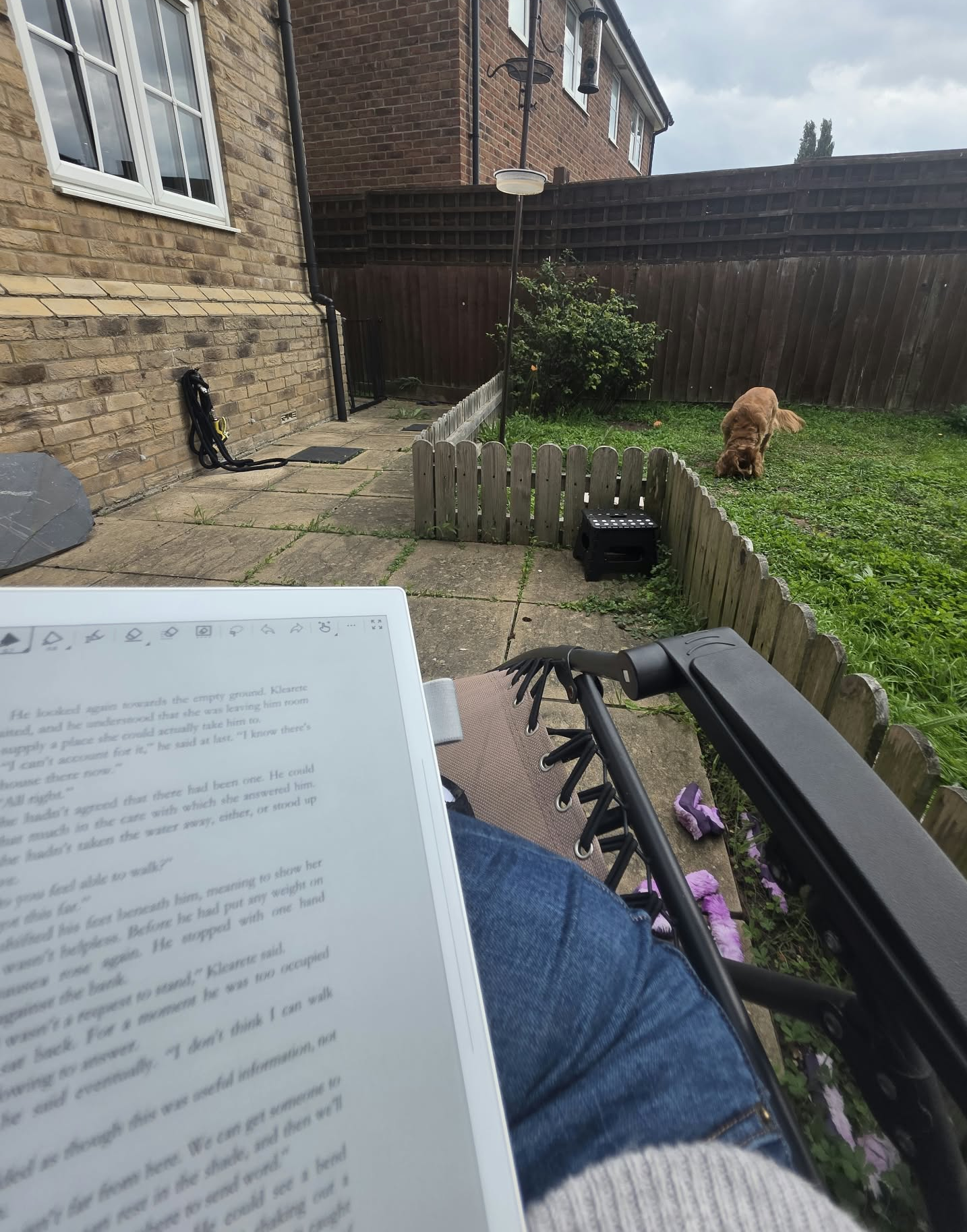
An annotated read-through on an e-ink device has been part of my process, alongside more focused passes. Changing the reading surface does not confer magical objectivity, but it changes the immediate relationship to the text.
For you, a printed copy or a different reading view might serve the same purpose. It can help to have a pass where you notice what reading feels like before turning every reaction into an instruction to rewrite.
“Something feels slow here” is a clue to investigate. It does not yet tell you whether the problem is repetition, weak stakes, an unclear goal, or a reader waiting for information you intended to withhold.
Test the suggestions
I have used ProWritingAid as part of revision. Its suggestions still need to make sense in the passage where they appear.
Is it identifying a grammatical problem? A repetition I had stopped noticing? A stylistic preference? Those are different categories, and accepting them indiscriminately would give the tool more authority than I want it to have.
Sometimes I agree with the problem and disagree with the suggested fix. Sometimes a phrase that looks needless on its own helps the rhythm or the character's perspective. A suggestion can be useful even when I reject its wording.
The challenge is keeping either response from becoming automatic. I do not want to reject every suggestion to protect my “voice,” or accept every one to make the page tidy. Reading the sentence in its paragraph, and sometimes the paragraph in its scene, gives me more to judge it by.
Protect the reasons behind a choice
In THEODOROS, I have paid close attention to character agency and emotional continuity: whether people make meaningful choices, and whether their changing feelings make sense. The reader needs to be able to follow how they arrive at an action.
Here is a hypothetical example, unrelated to the manuscript. A character refuses to help a relative, then agrees after learning that someone else will suffer if they do not. If an edit cuts that new information but keeps the agreement, the scene becomes shorter. It also loses the reason for the change of heart.
A check of individual sentences might miss that damage. The prose can still read smoothly. The gap appears when we ask what changed the character's mind.
After a substantial edit, I find that question more useful than asking whether the passage sounds polished. I want to check what the character now knows and chooses, and whether the reader has enough to follow the change.
Give the next pass a clear job
A long manuscript can produce a long, unhelpful list of worries. A little organization can make that list easier to work with.
I would suggest giving each pass a limited job and keeping a note of decisions still to make. “Improve Chapter Twelve” is hard to finish. “Check whether the decision at the end makes sense from what the character knows” gives you something specific to test.
Keeping a copy before a major change can help for the same reason. Add a brief note about why you made the edit, and a later comparison will not depend entirely on remembering what seemed wrong at the time.
You can adapt the system to the way you work. It only needs to leave enough of a trail for you to pick up the next decision.
What I want from revision is a manuscript I understand more clearly, including the reasons for keeping something. A sentence that stays can be the result of serious editing. Sometimes the useful outcome of a pass is that I can finally explain why it belongs.
Comments