From Sketch to Screen: Finding Keepwrite's Illustration Style

When I turned Keepwrite's blog into The Library, I thought I was simply reorganizing a few categories and giving the website a new look.
However, I am often guilty of one creative decision cascading into several more.
I wanted The Library to be more than a collection of articles. Each section needed its own personality, something that would invite visitors to explore. This led to my picking up my drawing tablet and getting to work.
Gathering References
Before settling on a composition, I spend time looking for reference material.
Historical maps, architecture, manuscripts, artwork, and museum collections can all help suggest details I might otherwise overlook.
I particularly enjoy finding public-domain or openly licensed materials that can inform a design. Sometimes they're useful simply as references. Other times, when the licensing permits, elements can be incorporated into the artwork itself.
The historical map used in the cover design for THEODOROS is one example of how archival material can add another layer of meaning without becoming the focus.
Building the Illustration in Stages
I prefer breaking an illustration into manageable stages rather than trying to perfect everything at once. Because I am a self-admitted perfectionist.
I begin by exploring the composition and establishing the main forms. At this point, linework helps me understand where the objects belong, how they relate to one another, and if any planned details should be moved or deleted. If anything needs to be changed at this stage, it is easier than if I decide at the end that a mountain needs to be deleted.

From there, I begin establishing the larger areas of color.
This is one of my favorite parts of the process because an illustration can feel surprisingly complete early on. Even without detailed shading or texture, the colors give the scene its atmosphere.
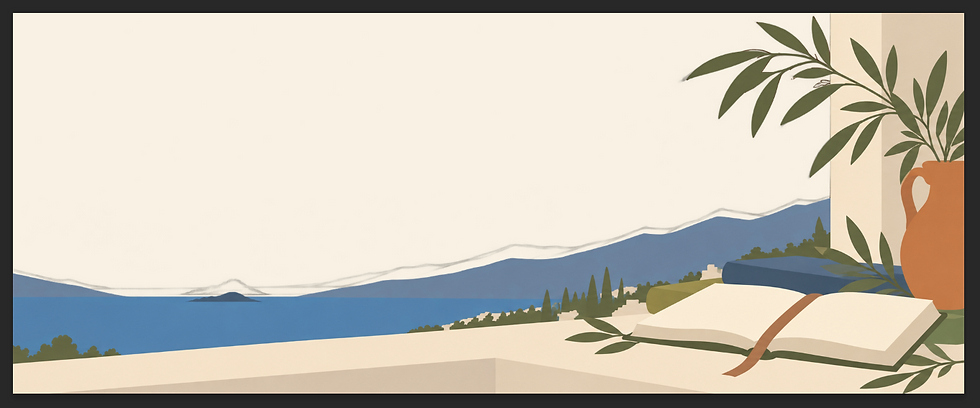
Once the broader forms are established, the smaller decisions begin. These include where a shadow falls, how to bring out the texture of a particular material, whether a line helps a figure, or whether it's better left out.
Though I grew up sketching out realistic figures with graphite, I've recently been drawn to illustrations with distinctive linework, restrained texture, and enough shading to give objects dimension without texturing every surface.

The pendant from THEODOROS offers another example. Its construction begins with a comparatively simple form, but the relationship between clay, bronze, and cord is important.


It's an evolving process, and sometimes simplifying an illustration takes just as much consideration as adding aditional detail.
From Traditional Art to Digital Illustration
Art has been part of my life since childhood. I grew up working with traditional materials, though I picked up my first drawing tablet when I was about 19.
Learning digital illustration meant becoming familiar with a different set of tools while carrying over much of what I already understood about drawing techniques, color, and composition.
Alongside the design work I've been doing while pursuing my graphic design degree, developing the illustrations for Keepwrite has given me a platform to connect my writing with my artwork.
I'm certainly still learning. But that's also part of what makes it fun.

An Identity That Can Grow
One of my goals is to develop a recognizable illustration style that can carry through Keepwrite, my book covers, and future projects.
I hope they will be visibilty connected through the thoughtful composition, intentional linework, natural color, and a sense that the illustration was designed purposefully.
For now, I'm enjoying seeing that identity take shape, one project at a time.
Of course, the artwork is only one part of the process. Behind the cover is a novel, and behind that novel are quite a few drafts, experiments, revisions, and unexpected discoveries that have rolled into future book ideas.
In an upcoming article, I'll share more about how I approach writing and developing my stories, and how that process has evolved.
A shameless plug
All right, one shameless plug before I go. 😂 The pendant you've seen taking shape above has found its way onto the finished cover of THEODOROS, Book One of The Gods Before Us. The Kindle edition is now available to pre-order ahead of its February 1, 2027 release. Pre-orders help a new book gather interest and visibility before publication, and they mean that when launch day arrives, there are already readers waiting for the story. For an independent debut, that early support means a great deal.
If a young god stranded in ancient Athens sounds like your kind of story, you can pre-order THEODOROS on Amazon. And thank you for following along with the art that brought it to life!


Comments